The End of my Suno Era

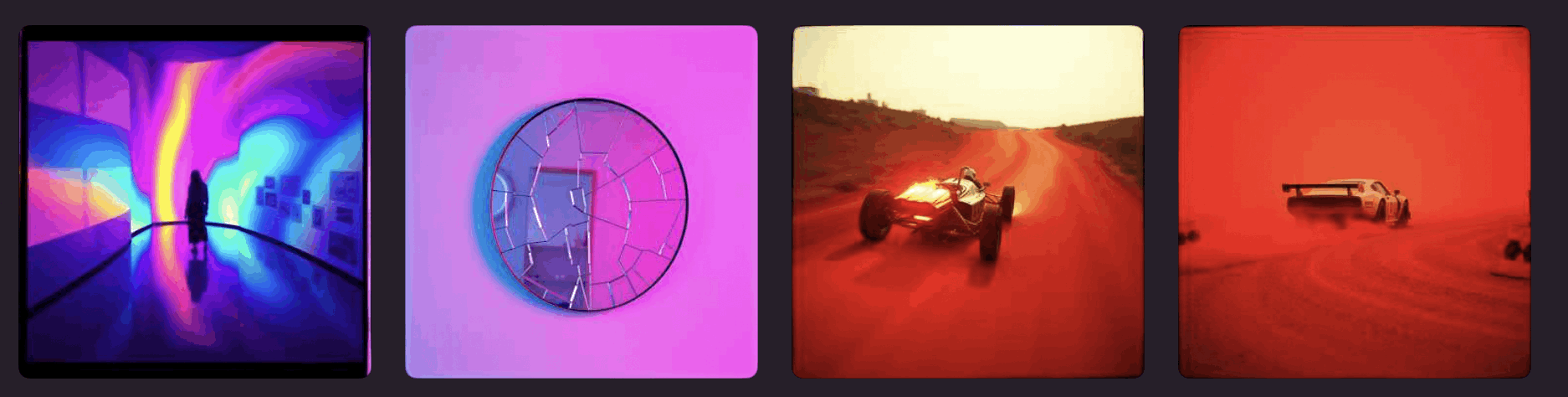
Today my second single as Alonzo, Breaking Heartbeat is live everywhere you stream music. If you're reading this blog for the first time because you gave your email address to me, thanks very much; I hope you'll stick around.
Both Breaking Heartbeat and Perfection, the song I released at the end of May, were written in 2025, while I was a student in a virtual production mentorship program spearheaded by Terence Lam. I'm proud of how they turned out, and I think they absolutely speak to the skills I built in Terence's program. There's also a pair of skills I was looking to build in this mentorship program that I am much closer to square one with than these songs might make it sound like: writing lyrics and fitting them to a melody.
The prompting of Perfection and Breaking Heartbeat
The lyrics (for the most part) and the accompanying melodies for both songs are generated. Suno, being the kind of poorly built, trying-to-find-a-market ugly duckling that it is (or was, I haven't kept up, and everybody tells me AI moves so fast), doesn't really work in a way that lets you add only lyrics and a melody.
It certainly tries though! I uploaded my demo beats and prompted it to keep the backing track as-is, prompted to generate lyrics, which I tweaked a little. Both songs were initially missing bridges, for instance. Since the bridge is in my opinion the best part of a song, so I added one to each, and further tweaked lines to be more believably me.
I thought I cracked the code when I was seventeen
Now I have more regrets than I have years left in me
The first two lines of the second verse of Perfection are a great example: the bulk of this couplet is generated. "Seventeen" and "cracked the code" are definitely tweaked to be more... in-universe if you will: I really did feel like I cracked the code when I was seventeen; that's how old I was when I came out and left the church I grew up in. Do I have more regrets than I have years left in me? Thankfully usually not, that was the clanker's idea, but it is a lie I can sing truthfully.
With the lyrics more or less sorted and audio (optionally) uploaded, you describe the song you want. For me this amounted to giving stage directions for the kind of singing I wanted it to hit me with. Suno probably won't let you just say "Justin Bieber", but you can girlboss pretty close to that sun if you know how to use your words.
The Outtakes
Suno gives you a pair of takes, demonstrating mainly that the company isn't proud enough of their output to just pick one. The outtakes of Perfection and Breaking Heartbeat (which at this point was titled "Overdrive Heartbeat") are kinda fun; I'll share unlisted links to them below.
The outtake for Perfection is kind of unusably messy: the song stumbles in a "changing-the-channel" way as it gets a little too far off the rails. But at the same time, it has more club energy than the track I wound up recording and plenty of creative moments. When I perform Perfection live, I'd like to keep this rendition in mind, since the studio version isn't really made for human lung capacity.
The outtake for Breaking Heartbeat is definitely a bit more towards the soul end of R&B than I can really claim, and correspondingly makes my backing track more classy in ways that I wasn't really interested in duplicating.
The reason the title changed, by the way, is that I'm a slightly better lyricist than just the clanker alone would be: "Overdrive" is three syllables, but in the chorus of the song there's really only space to sing two comfortably. There's plenty of car imagery in the other lyrics (and in some of the ear candy I added while mixing), I figured I don't gotta sing a whole paragraph.
Recording
Terence helped convince me to go this route by arguing that I would get more practice at singing, recording, mixing and finishing songs with a more conventional feel than the ones on my 2022 album as Alanza. This is definitely true! Recording Perfection in particular was a huge learning opportunity at a steep curve.
My process was: I took the stems that Suno (using yet another machine learning process) extracted from its better take and lined them up with my demo beat. For Perfection, this involved a fun little rearrangement: my demo has a build-up for a drop that still survives in the published track but which is timed to ... partway through my breathlessly long prechorus. Then I tried to sing my own version as best as I could.
I learned way late in the process that singing along to an existing demo tends to produce worse takes than doing my own rendition without a net. The final recordings of both songs are comped together from multiple takes, as is standard in this genre. Initially I shared a demo with friends where I meticulously tried to take the very best rendition of each word and stitch them together. Perhaps unsurprisingly, this actually makes the vibe of the performance fall apart.
Finishing
With the vocals recorded, I could delete the Suno stems (although there is a piece of ear candy at the line "work I put in" in Perfection which I left in) and work on finishing the tracks.
With Learning To Run I still didn't really get the differences between "songwriting", "recording", "production", "mixing" and "mastering". It's true that the lines are quite blurry, but I do think I've gotten a better sense about why these are thought of as separate processes.
Some "production" things which happened after recording: adding ear candy (in Breaking Heartbeat, see if you can just listen for car noises) and some extra layers to the synths in each song's choruses. In Breaking Heartbeat I discovered that I wanted to record my piano, and although I didn't put much thought at all into mic-ing it, I'm pretty happy with the results!
Perfection was mixed mostly on the final day of a math conference I spoke at in New Jersey. Mixing and mastering can feel like dark arts. For mastering especially, I think for a while this was a marketing gimmick, and now is partly just the way the plugins are mainly machine learning and few knobs. If you have a reference track to compare with, though, and the patience to overcorrect and then back off many times, it's not so bad. A good EQ plugin can even compare the frequency content of your master track to a reference track and attempt to make them similar!
For Breaking Heartbeat, the EQ initially gave me this massive bass boost, since perhaps out of respect for my neighbors across the wall I had kept my bass fairly tame. After about half an hour of accepting the EQ revisions as tweaks to the master channel, it occurred to me that this really is a mixing problem and should be solved by boosting the bassline, at least in the frequencies it owns. As a result of this attention to detail, the Spatial Audio mix of Breaking Heartbeat is much better than Perfection's.
What's Next?
Initially I wanted to try and put out a song every month or two. Spotify believes (or did last year maybe) that this is the best way to grow a streaming fanbase. If that winds up happening I won't be mad about it, but right now I don't have anything at the stage Breaking Heartbeat was in when I released Perfection.
Instead I have a story that's probably at least the size of an EP I want to tell, so I'm gonna water that seed and let you know more when I have something to say.