2025 In Books

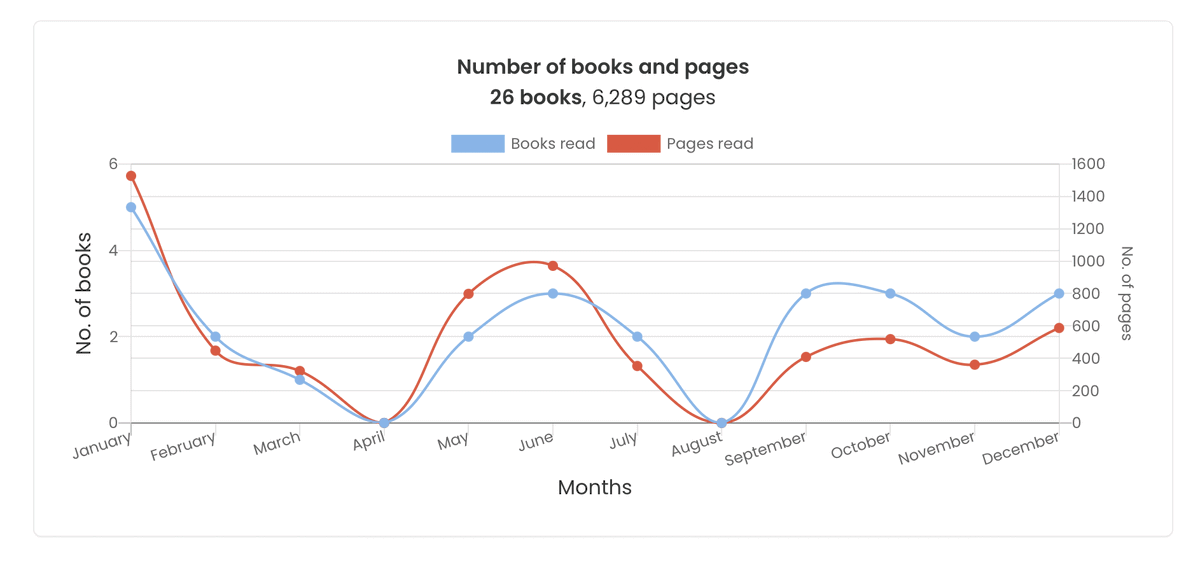
and by "in books," I mean "in books that I read, almost all of which did not come out or trend in 2025".
I started using The StoryGraph in 2024; I think it came recommended to me as a Goodreads alternative by several people in my neighborhood book club. I never really used Goodreads, and I'm sure that I'm not using The StoryGraph in the way it most wants to be used, either.
I was somewhat chagrined to discover at the end of 2024 that I only read 15 books and wanted to double that. Although I did better (as you can see above), and I might finish Bleeding Edge by Thomas Pynchon before January 1, I'm not likely to hit 30 books.
That being said, I loved a lot of what I read this year, so I wanted to tell you about it. Here's a little bit about all of them, organized roughly by vibe. The first group is also the biggest, which is a bit of a self-own.
Self-Help / Life Philosophy
The Courage to Be Disliked – Ichiro Kishimi and Fumitake Koga.
This book is essentially a Socratic dialogue between a philosopher (more or less a Kishimi self-insert?) and a young man. The young man hears that the philosopher says that life is simple and anyone can be happy and is kind of incensed by this and vows to argue him into giving up these positions. The positions are heavily influenced by the psychological theories of Alfred Adler, a contemporary of Freud.
I finished this before Trump's second inauguration, but even heading into it, you can probably imagine the vibes were pretty ripe for sympathizing with the young man. I really liked this book; I think it was really helpful for identifying things that really are not "my task", as the book puts it, and starting to let go of them.
The Bonds that Make us Free – C. Terry Warner
I found this book surprisingly harmonious with the other books I read in this section, although it seems to me to be pitched for a somewhat different audience. Warner is a Mormon (I also grew up Mormon), and is charmingly doing his best to be secular—charmingly, in part because of what does and doesn't really land as secular for me.
What I really loved about this book was its theory of communication and conflict. Similar to The Courage to Be Disliked, it posits that relationships and healing can be easy; the core challenge is about putting down one's ego and sense of hurt to listen for what needs to be done.
Four Thousand Weeks: Time Management for Mortals – Oliver Burkeman
How to grapple with finitude? How to accept that there are plenty of things that you will never get to? What to do if your time management, productivity hamster wheel doesn't provide fulfillment?
The Art of Communicating – Thích Nhất Hạnh
I think I saw this book in a bookstore sometime in 2024 and was like "good thing I'm a professional communicator, it would be really embarrassing to need to read this book" and then saw it again and was like "you know, maybe I could really use the help". The book is about (in part) navigating conflict. In a year that I spent a lot of time grappling with a scale of presence and intensity of emotions that I maybe cannot match at any other time in my life, it was a helpful signpost.
Love in a F*cked-Up World: How to Build Relationships, Hook Up and Raise Hell Together – Dean Spade
I love how uncomfortable this book is about being a self-help book. Similar to The Anarchist Cookbook (below), I was surprised to find in myself a gentle eyeroll about the politics of this book? Broadly speaking, I'd say I'm very aligned with both books and their authors. I wonder how much of the difference comes down to me not being in politics as an industry.
I've found myself coming back to its image of the pendulum ("I'm not the best, I'm not the worst") a couple times when grappling with shame.
Fear – Thích Nhất Hạnh
I've read several Thich Nhat Hanh books over the past two years, and I think this one ranks near the top for me in terms of how to sit with heavy emotions in meditation.
The Artist's Way – Julia Cameron
Really grateful to have had a little crew come together to do the twelve weeks of this book as a book club. Over the summer I went on a couple dates with a guy who had done it a while ago. He wanted to know whether the morning pages had faded from being a powerful practice into a routine. I think in the same conversation I mistook him saying "I want to stake all these claims as a writer" for asking for permission to stake claims. (Often the thing I am denying myself is permission, but I am discovering that this is not the dominant thing missing for everyone.)
I Thought it was Just Me (But it Isn't!) – Brené Brown
This book is all about Brené's research on women and shame. Her understanding of how shame functions, the ways we respond to feeling shame, and how we might practice resilience in the face of it (including, interestingly, trying consciously to move from "shame" to "guilt", which she argues is a logically distinct and more useful emotion).
Frequently I was a little annoyed—even as I understood why it might be useful—at her choice to narrowly focus on women. At the very end of the book, she discusses some of her then-new research on men and shame. As I could have told her as a reader, she concludes that humans are more similar than different in how we feel shame and what it threatens for us. The differences in the causes of and socially-permissible responses to shame appear to differ for women and men more or less because the social scripts for what being a "good" or "successful" person differ along gender lines.
Far more frequently, though, I found myself breathing very intentionally as I read, as the discussion happened quite frequently to feel (usefully) heavy to me.
Politics
Living My Life, Vol. 1 – Emma Goldman
I loved this book which was the December book for book club but took me a little into January to finish, yea, even unto thinking "dang, I should read (auto)biographies of cool historical figures more often". I hadn't really heard of Emma Goldman previously: she became one of the early 20th century's most prominent anarchists. She was ultimately stripped of her US citizenship and deported to the USSR along with her lifelong friend Alexander Berkman who was sentenced to 22 years in prison for attempting and failing to assassinate Henry Clay Frick.
Her autobiography covers decades and decades of her storied life. At one point, for instance, she is jailed on suspicion of having plotted the assassination of William McKinley, whom she offers to nurse (a career she more or less picks up on the side over the course of most of a decade). At other times she is touring the US and England giving public lectures on anarchism. The story of her time in the USSR is fascinating in part to see her detail her grappling with how far the distance is between her embrace of communism as a fellow form of leftism and Lenin's Soviet Russia.
But maybe the best part of the book is how human she is. She's hot, she falls hard and repeatedly for men, she struggles to take even a moment for herself.
The Anarchist Cookbook – Keith McHenry and Chaz Bufe
(There is another book of the same title; this one is more aligned with Food Not Bombs—there are literally recipes—than about teaching you how to make a Molotov cocktail or whatever.)
I really appreciated the book reprinting "You can't blow up a social relationship", a pamphlet from the late 70s in Australia that discusses "the anarchist case against terrorism". I think I also finished this book in early January. In those days, with Trump ascendent, it was frustrating in the extreme to be surrounded by a mix of "violence-chic" sentiments and "we must flee for Europe", both in my estimation tone-deaf and performative, but somehow not happy with each other.
"You Just Need to Lose Weight" and 19 other Myths about Fat People – Aubrey Gordon
This was another book club pick, and I was a bit dismayed to really dislike it. The framing of the book itself probably does not lend well to a comfortable experience writing or reading. Frequently I found myself wishing Gordon would bring in more of her personal experience and a little less of the tetchy analysis of science and culture. Not (I hope) in an effort to make her put on a display of her pain, but because I felt like the book made very little attempt to connect with a reader, which made it difficult to enjoy.
Fiction
Love in a Fallen City – Eileen Chang
This is a collection of short stories, mostly set in Hong Kong and Shanghai at the beginning of the 20th century, written by Eileen Chang. I was really struck by how, even in the quite apparent differences in cultural context, each of the stories felt truly alive and relevant. Almost all of them do not end happy. War and political oppression is a tacit presence. An incredible book club pick.
Lote – Shola von Reinhold
An incredibly inventive story of a Black woman who routinely "escapes" by reinventing herself with a new name and fake backstory in order to pass as a temporarily indisposed wealthy person with a new set of gullible, largely white acquaintances.
Most of the book takes place at a beautifully "is this for real?" artist's retreat and centers around the main character's "Transfixions"—totemic obsessions with historical figures who represent the main character back to herself.
Loved and Missed – Susie Boyt
A complicated, multigenerational story of a single mother who doesn't exactly kidnap her drug-addicted daughter's child and raise her as another daughter, but she doesn't not do that either. For me the sometimes terrifying contrast between what the main character thinks and what she says was incredibly well done.
Chapterhouse: Dune – Frank Herbert
I read the first 5 Dune books between 2021 and 2023 and picked up this one at that time. In a universe beautifully stuffed with inventive explorations of religions familiar in their strangeness, I was really dismayed to discover that for this one Frank had decided "you know, what if we just put literal Jews in space". I trust him to spin a good yarn, but the politics on display in the first 5 books did not engender a lot of trust in his ability to do a good job, so I put it down.
I forgot what prompted me to pick the book back up—maybe the same kind of magnanimity that has me seriously eyeing giving Infinite Jest another go in 2026. It turns out to be probably my favorite of the 6 books (I'm not intending to read any of the Brian Herbert Dune books, thanks all the same): the protagonist being the Reverend Mother of the Bene Gesserit made for a fascinating point of view to explore at a pivotal moment in their history.
As Lie is to Grin – Simeon Marsalis
This was my suggestion to the book club; Simeon is a colleague of mine at Rutgers–Newark. He told me that people described this book to him as "autofiction"—since the main character is a Black man who is (for most of the book) a first-year student at the University of Vermont set at the same time that Simeon was a first-year student at the University of Vermont.
I found the book a really fascinating picture (similar to Loved and Missed) of the inside of a very particular head. The story details several lies the main character tells, and is gently also about a mental health crisis in a way that I found really relatable.
On the Calculation of Volume I – Solvej Balle
This is a "Groundhog Day" style novel set hundreds of iterations into the main character's repeated day. You see her slow panic, her pulling away from the connections she has to the rest of the world. I'm excited to read more of the series in 2026.
Japanese
鬼滅の刃・吾峠呼世晴 (Vol. 1, 2)
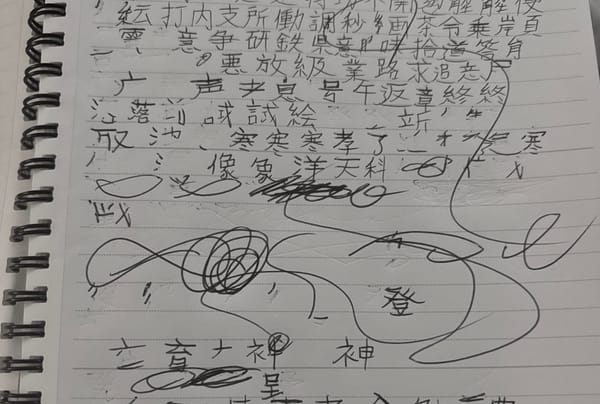
This is the "Demon Slayer, Kimetsu no Yaiba" manga series. Andrew Kelley gave me his copy of Volume 1 when we met over the summer. I was really excited that, unlike the light novel series I had been trying to read, the manga had furigana (pronunciations) for all of the kanji (Chinese characters) in the text, and that a good number of the words at the beginning of the manga were familiar to me already.
Ultimately I found reading a slog, since I still ran across an unfamiliar word every other sentence or so, but I'm hopeful that I'll be better-positioned to pick them back up in 2026.
レベル別日本語多読ライブラリー "Japanese Graded Reader Library" (Vol. 1 of Levels 0–4)
After acknowledging the difficulty of Demon Slayer, on kind of a whim in the midtown Kinokuniya (on one of my Julia Cameron-mandated "artist dates") I picked up one of the level 0 readers and was astounded and delighted to discover that I could read the whole thing. Each volume has 5 or so short books, each usually with some illustration. I found many of the stories in the later volumes (stories about, for instance, an elephant brought to the Ueno Zoo near Tokyo in the 1920s, or a radiologist who survived the atom bomb in Hiroshima) profoundly affecting.
I really appreciated that the stories were comprehensible with my limited vocabulary, but still had worth reading on their own. I'm edging my way towards literacy and itching for the ability to read "real" books. Reading these put me in mind of the voracious way I read all sorts of stuff as a child, aiming for more and more literacy.
どんどん読める!日本語ショートストーリーズ
This is a collection of short stories pitched at an intermediate level of Japanese. I appreciated the book for having a wider collection of stories. Most of them were quite short, though, frustratingly so.
小説ミラーさん (Mr. Miller, a novel) – 横山悠太
This is a (short) novel-length book, also at an intermediate level of Japanese. It follows Mr. Miller, an American who moves to Osaka to work at a tech company. Unfortunately not much really happens? He makes friends and tries unsuccessfully to date and encounters Japanese culture with a limited vocabulary. As far as non-manga goes, it seems like I might have to trade in favor of needing to accept some non-understanding for more plot.